
Do Florida Apartment Owners Need Board Approval for EV Charging? No — Here's Why
A resident on a six-month lease asks the leasing office if the property has an EV charger. Nobody knows the answer, so someone starts looking into what it takes to add one. The first search results are all about condo boards: special assessments, membership votes, Florida Statute 718.113. None of it applies to the building in question.
That confusion is common, and it's worth clearing up directly. Florida's EV charging conversation has been dominated by condominiums and homeowners' associations — communities built around boards, unit owners, and statutes written specifically for them. A privately owned apartment community runs on a different structure entirely. There's no board to petition, no unit owners to poll, and no statute written with an apartment complex in mind.
That difference isn't a technicality. It changes how the decision gets made and how fast it can move.
Short answer: No. Florida Statute Chapter 718 governs condominiums and Chapter 720 governs homeowners' associations — both are written for communities with boards, unit owners, and membership-vote structures. A standard rental apartment community has none of that. It has a single owner or ownership entity, and installing EV charging is an ordinary capital or operating decision, made the same way the property would decide on any other amenity or capital improvement.
Does Florida's Condo EV Charging Law Apply to an Apartment Community?
No. Fla. Stat. 718.113(8) and (9) are condominium-specific provisions that sit inside Chapter 718. Subsection (8) addresses how a condo board must respond to a unit owner's written request to install a charger in their own parking space. Subsection (9) addresses whether a board's decision to install charging on common elements counts as a "material alteration" requiring a full membership vote — generally, it does not.
Both subsections assume a structure that a rental apartment community doesn't have: unit owners, common elements, and a board that answers to them. A standard apartment complex has none of that. There's a single owner, or an ownership entity, that holds the whole property. There is no association and no board, so there's no membership-vote structure to trigger in the first place — not because the law exempts apartments from a vote, but because the governance structure the vote requirements are written around simply doesn't exist there. Unlike condominiums, which navigate 718.113 directly on every install, apartment owners are outside that statute entirely.
What a Condo Board Has to Navigate — and What an Apartment Owner Doesn't
A condo board considering EV charging has real process to work through. It has to evaluate a unit owner's request against the conditions 718.113(8) allows the association to apply. It has to determine whether an install counts as a material alteration under 718.113(9) and whether that triggers a vote. It has to document the decision for the board packet and be ready to explain it at the next meeting, because a board that gets this wrong can face a challenge from an owner or a lawsuit over the decision.
An apartment owner has none of that to satisfy. No unit-owner request to evaluate, no material-alteration question to answer, no vote to schedule, no board meeting to wait for. This is a genuine speed advantage, not just a legal footnote: the decision can move at the pace of ordinary capital planning — a site visit, a proposal, a signed agreement — instead of a board calendar that might not have an open slot for another six weeks.
The Business Case for Charging at an Apartment Community
Speed matters because the demand is already showing up in leasing conversations. A 2024 SWTCH Energy survey of 1,567 multifamily residents across Boston, Chicago, Los Angeles, and Miami/Tampa found that 62% of multifamily residents plan to own or drive an EV within five years when charging is available at their property, compared with 25% when it isn't. The same survey found that 31% of non-EV owners cite the lack of building charging as a barrier to signing a lease.
For an apartment owner or asset manager, that's not a sustainability talking point — it's a retention and leasing-velocity number. A resident who plans to go electric within five years is a resident more likely to renew if the charger is already there when the lease is up, and less likely to renew if it isn't. A prospective tenant who rules out a property over missing charging is a vacancy that didn't need to happen. Florida Chargers works with apartment owners and asset managers across Florida on exactly this calculation — see the multifamily overview for how a property typically approaches it.
Planning Numbers: What It Costs and How Long It Takes
For budgeting purposes, Florida Chargers installs at $5,000 to $8,000 per port before incentives, with 6 to 12 weeks from signed agreement to energized charger. As a starting point, Florida Chargers sizes multifamily installs around one Level 2 port per 20 to 30 units, then adjusts based on the property's actual electrical capacity and parking layout. Those benchmarks track closely with what condo properties pay per port for the same hardware, and a deeper cost breakdown is available for comparison.
A site assessment turns these ranges into a specific number for a specific property — panel capacity, conduit runs, and where the parking is located all move the estimate, and Florida Chargers doesn't quote a job without seeing the site first.
One Charger, Every Car
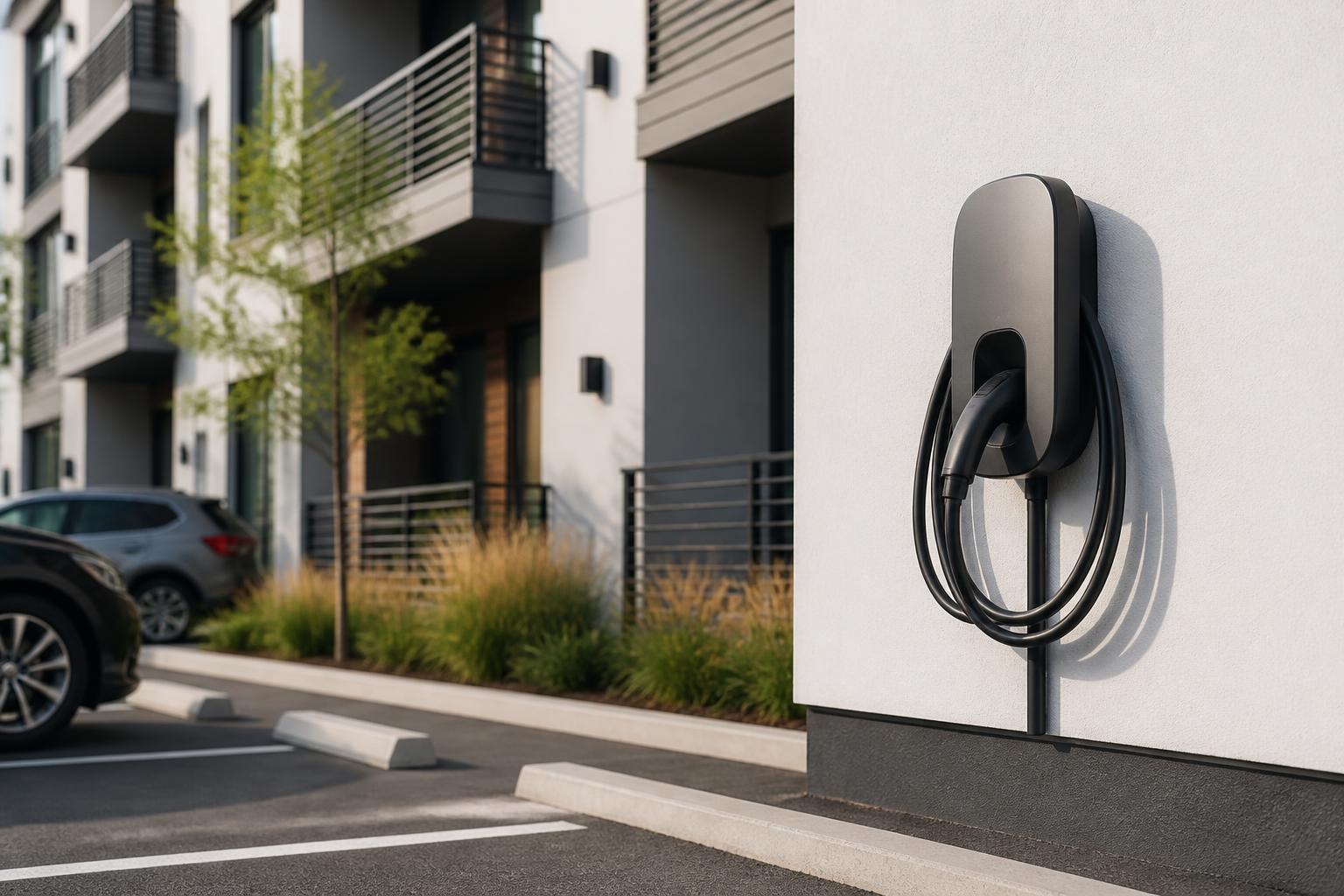
Every install uses the Tesla Universal Wall Connector: Level 2, 48 amps, 11.5 kW, with a NACS connector and a built-in J1772 adapter. That adapter is the detail that matters for a mixed-resident population. It means the charger plugs into a Tesla directly and into every J1772-equipped EV on the market with the adapter that ships in the box. An apartment community doesn't need to guess what its residents will drive next year. One charger handles both.
This article is for informational purposes only and does not constitute legal advice. Consult a licensed Florida attorney for guidance specific to your property.
Florida Chargers is a veteran-owned, Tesla Certified commercial EV installer serving apartment owners and asset managers across Florida. Florida Chargers handles the site assessment, the install, and the ongoing hardware so the property gets working chargers without adding headcount or guesswork to the process. Reach out for a no-pressure free site assessment. Call 321-475-2689 or visit flchargers.com.
Frequently asked questions
Want a real number for your property?
Free site assessment — we'll walk the parking, check the electrical, and give you a straight, board-ready proposal.
Request a free site assessment