
Clermont · Lake County
EV Charger Installation for Clermont Communities
Florida Chargers installs networked Tesla Universal Wall Connectors for Lake County 55-plus communities, lakefront condominium associations, and the newer subdivisions along the 27 and 50 corridors.
The most common assumption about Clermont is that a 55-plus community does not need EV charging. Board rosters keep proving otherwise. Retirees buying a new vehicle in 2026 are buying from a lineup that is increasingly electric, and the resident who bought one usually arrives at the board meeting with a written request rather than a question.
Florida Chargers is a veteran-owned, Tesla Certified commercial EV charging reseller and installer based in Winter Garden, roughly 12 miles east of Clermont. Florida Chargers designs, installs, manages, and maintains Level 2 charging for Lake County condominium associations, active-adult communities, and apartment owners under FL Certified Electrical Contractor license EC13009718.
Statewide context for a board weighing whether this is a passing trend: Florida has 450,400 registered EVs, second only to California's 1,843,100, out of 5,689,100 nationwide, according to U.S. Department of Energy Alternative Fuels Data Center 2025 data.
What Florida Chargers installs in Clermont
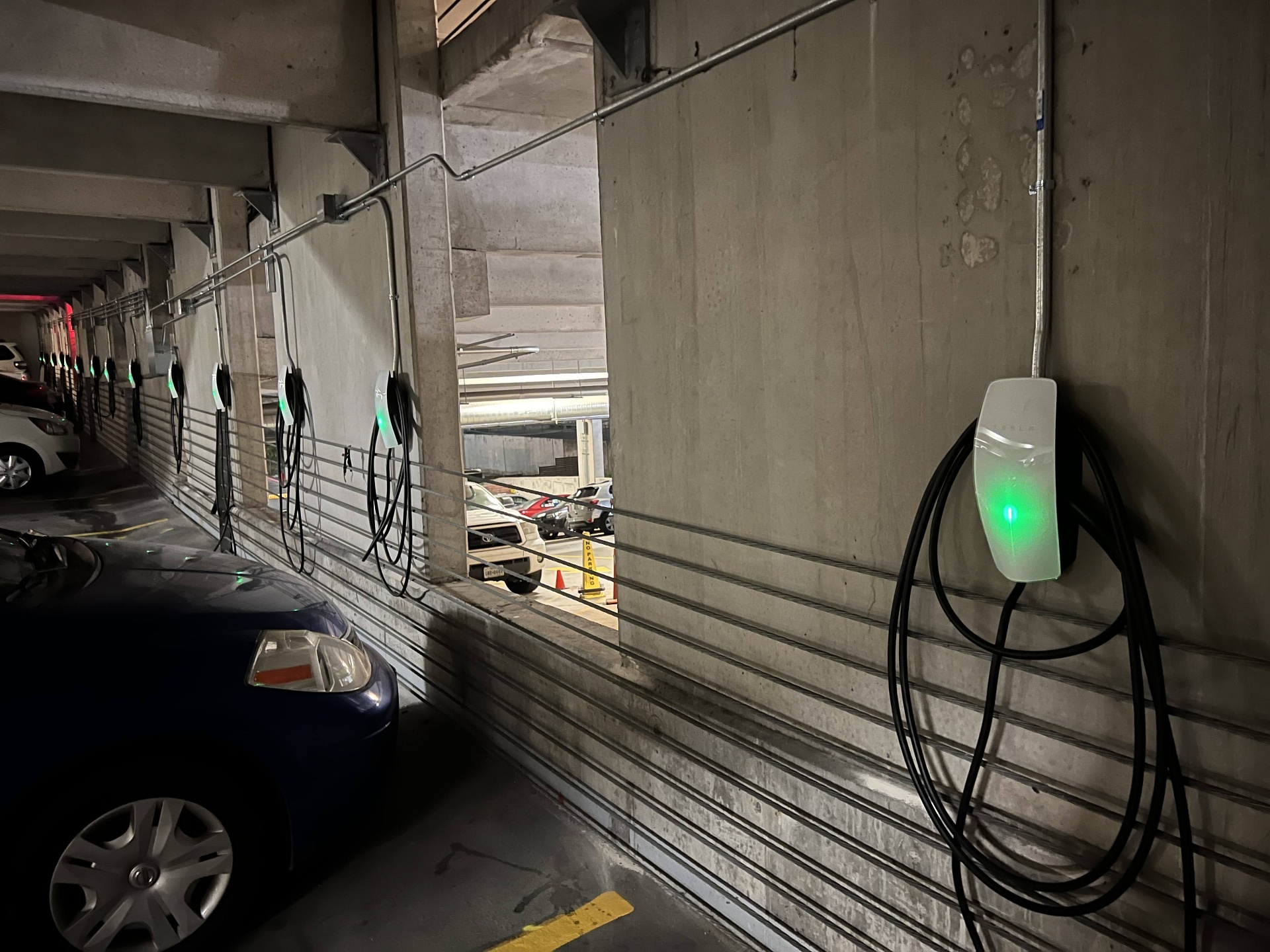
The hardware is the Tesla Universal Wall Connector: a Level 2 unit rated at 48 amps and 11.5 kW, with a NACS connector and a built-in J1772 adapter. It plugs straight into a Tesla and charges every other major EV brand through the adapter that is already attached, so a property is not choosing a charger that serves one brand of car. Load sharing spreads available circuit capacity across multiple ports, which is what keeps a project from turning into a service upgrade.
Florida Chargers designs, installs, manages, and maintains the system, and the chargers are eligible for listing in the Tesla app once commissioned by a Tesla Certified Installer with reliable connectivity (Tesla makes the final listing decision), so nearby drivers can be routed to the property.
The built-in J1772 adapter is worth naming specifically in a 55-plus community. Resident vehicles skew across brands, and a single hardware standard that serves a Tesla, a Mustang Mach-E, and an Ioniq without a separate adapter avoids the objection that the association is buying charging for one make of car.
A common starting point for multifamily is roughly one Level 2 port per 20 to 30 units, then adding ports as usage data comes in.
Who this is for in Clermont
55-plus and active-adult communities. Clermont and Minneola carry a large share of Lake County's age-restricted housing, much of it built around shared amenity centers with their own electrical service and adjacent guest parking. That amenity-center parking is frequently the best first location for charging: the panel is close, the pavement is already there, and the spaces are common area rather than assigned. It also sidesteps the harder question of assigned-space installations in a community where residents park in detached carports.
Lakefront condominium associations. The buildings around Lake Minneola and the Clermont chain of lakes are the ones where Fla. Stat. 718.113 actually applies. Fla. Stat. 718.113(8) says the board may not prohibit a unit owner from installing a charger in the owner's limited common element or exclusively designated parking area, subject to the subsection's conditions. Fla. Stat. 718.113(9) says board installation on the common elements is not a material alteration, so it generally does not require a full membership vote. Chapter 718 governs condominiums and Chapter 720 governs HOAs, so neither subsection reaches an HOA or a rental community. Many declarations contain their own material-alteration provisions, so confirm with association counsel before relying on either subsection.
Newer subdivisions and rental communities. The growth along US 27, Hancock Road, and the Highway 50 corridor toward Four Corners produced newer apartment and build-to-rent communities with modern electrical service. Those properties compete for the same commuting households that consider Winter Garden and Horizons West, where charging is becoming standard. In a 2024 SWTCH Energy survey of 1,567 multifamily residents, 62% said they plan to own or drive an EV within five years when charging is available at their property, against 25% when it is not, and 31% of non-EV owners named the absence of building charging as a barrier.
Your utility and what it pays for
Clermont properties are served by Duke Energy Florida.
The Duke Energy Florida Commercial Charger Prep Credit is active. It covers wiring, panel, and conduit work, and it explicitly excludes hardware and permits. That distinction matters when a board is reading a proposal: the credit offsets the electrical infrastructure, not the chargers. Florida Chargers confirms the current terms with Duke as part of the proposal rather than quoting a number that may have changed.
Florida SB 1084 (2024) preempted the regulation of EV charging stations to the state; since July 1, 2024, local governments may not enact or enforce their own EV-charging ordinances. The electrical permit itself is still issued locally. That is a good thing for a board or an owner: a property installs charging because the amenity economics work, not because a local ordinance forced the decision.
Permitting and timeline
Electrical permits for properties inside the city limits are issued by the City of Clermont. Communities in unincorporated Lake County, including much of the Four Corners area, permit through Lake County. Age-restricted communities with a private amenity association sometimes also have an internal architectural review step, which Florida Chargers plans around when sequencing the project.
A typical project runs 6 to 12 weeks from signed agreement to energized chargers. That window covers design, permitting, utility coordination, installation, and commissioning. Florida Chargers pulls the electrical permit under FL Certified Electrical Contractor license EC13009718.
What it costs
Installed cost runs $5,000 to $8,000 per port before incentives. The spread comes from trenching distance to the panel, available panel capacity, wall-mounted versus pedestal placement, port count, and whether the path is concrete or landscaping.
Clermont's terrain and lot layouts can push trenching longer than a flat Orange County site, particularly on lakefront parcels where the electrical room sits well uphill from resident parking. Amenity-center installations usually come in lower for the opposite reason.
Under Share the Revenue, the property invests in the professional installation and Florida Chargers owns and operates the chargers — then the property earns 50% of net charging profit for the full term. Tesla Wall Connector hardware is included. Financing is available for qualified properties to cover the electrical infrastructure and installation with no money down, so a project can start without a capital outlay from reserves or a special assessment. Exact economics are confirmed during the free site assessment.
To model the numbers for a specific property, use the EV charging ROI calculator.
Clermont EV charging questions
This is for informational purposes only and does not constitute legal advice. Consult a licensed Florida attorney for guidance specific to your association.
Keep reading
- Commercial EV charging in Florida
Statewide overview of hardware, programs, and installation scope.
- EV charging ROI calculator
Model ports, usage, and revenue before taking it to the board.
- Florida HOA and condo EV charger law
How 718.113(8) and (9) work, and where Chapter 720 differs.
- Winter Garden EV charger installation
Newer West Orange multifamily and townhome communities.
- Orlando EV charger installation
Large multifamily, hotels, and office parks across Orange County.
- Seminole County EV charger installation
Established condo associations in Oviedo, Winter Springs, and Casselberry.
Get a straight number for your Clermont property
Florida Chargers walks the parking, checks the panel, confirms the serving utility, and returns a board-ready proposal. Veteran-owned, FL Certified Electrical Contractor EC13009718. Call 321-475-2689 or email info@flchargers.com.
Request a free site assessment