
The EV Charging Policy Every Florida Condo Board Should Adopt Before the First Request
The request usually shows up as an email to the property manager, or a resident standing up during owner comments at the annual meeting. "My Tesla sat on a Supercharger wait list for forty minutes last week. Can I put a charger in my parking space?"
Most Florida condo boards have never discussed this before that moment. There is no committee, no vendor on file, no shared sense of what "reasonable" means under state law. So the board tables it, promises to look into it, and the owner leaves without an answer — or with a verbal maybe that nobody wrote down.
That gap is the risk. Florida Statute 718.113(8) says a board may not prohibit a unit owner from installing a charging station within the owner's limited common element or exclusively designated parking area, subject to the subsection's conditions. A board with no criteria, no process, and no paper trail has nothing to point to if that decision, or that delay, is ever challenged. A board that already has a written policy on the books, applied the same way to every owner who asks, is in a much stronger position.
Short answer: A Florida condo board's EV charging policy should cover seven things: an approved hardware and installation standard, a requirement that a licensed electrical contractor pull the permit, rules on where equipment may be mounted and how it should look, an insurance and indemnification clause, a defined timeline for reviewing requests, a record-keeping requirement, and a clear statement of how the policy treats an individual owner's request under 718.113(8) versus an association-installed system on the common elements under 718.113(9). Adopting all of this before the first request arrives, instead of negotiating it case by case, is the strongest defense against a future claim that the board applied the statute's conditions inconsistently.
Why Adopt a Policy Before the First Request Arrives?
A board that negotiates its first EV charger request from scratch is, in effect, writing policy in real time, under pressure, for one specific owner. Whatever it decides becomes the unwritten precedent for the second owner, and the third. If those later decisions differ even slightly — a faster approval, a different mounting rule, a different insurance ask — the board has created exactly the kind of inconsistency that supports a claim of unreasonable treatment.
A written policy solves this before it starts. It gives every future request the same checklist, the same timeline, and the same documentation, regardless of who is asking or how the board feels about that particular owner. That consistency is the practical meaning of "reasonable" under 718.113(8): not that every request must be approved, but that every request is evaluated the same way. It also gives the property manager or CAM something concrete to hand an owner on day one instead of fielding the same questions meeting after meeting.
What an Approved Hardware and Installation Standard Should Require
The policy should name a hardware standard rather than leaving it open. At minimum: a UL-listed Level 2 charging unit, professionally installed rather than a plug-in or extension-cord arrangement. Extension cords run under garage doors and across parking aisles are a trip hazard and a fire-code problem, and they are usually what a board is trying to prevent when an ad hoc request first comes in.
The policy should also require that installation be performed by a Florida-licensed electrical contractor, with a permit pulled through the local building department. This protects the association two ways: it keeps unpermitted electrical work off the property, and it creates a paper trail — a permit record — that documents exactly what was installed and by whom. A board that specifies this once in policy does not have to evaluate an electrician's credentials on every individual request.
Location, Aesthetics, and Insurance: The Practical Details
The policy should specify where equipment may be mounted, and any aesthetic requirements for units visible from a common walkway, garage aisle, or the street — matching conduit paint to the wall color, routing conduit along existing lines rather than across a facade, keeping the unit within the owner's designated space rather than encroaching on a neighboring one. None of this needs to be elaborate. It just needs to exist, so an owner knows the rule going in rather than discovering it after installation.
An insurance and indemnification clause belongs in the policy too. A common approach is requiring the owner to carry appropriate coverage on the equipment and to indemnify the association for damage or liability arising from it. The specifics of that clause are a legal drafting question for association counsel, not something to improvise board to board.
Response Timeline and Record-Keeping
The policy should set a defined window for board or committee review — for example, a fixed number of days from a complete written request to a decision. An owner is far less likely to characterize a delay as unreasonable if the association can point to a published timeline it consistently meets.
Equally important: every request, approval, denial, and the reasoning behind it should be documented and kept on file. This is what actually protects a board under 718.113(8). If a future request is denied, and that denial is ever questioned, the record of how every prior request was handled is the evidence that the decision was consistent rather than arbitrary. A policy without record-keeping is a policy that cannot prove it was followed.
One Owner's Space vs. the Whole Property — Where (8) and (9) Diverge
The policy should also say, in plain terms, that Florida law treats two different scenarios differently. Under 718.113(8), an individual owner can request a charger for their own limited common element or exclusively designated parking area, and the board may not prohibit it, subject to the subsection's conditions. Under 718.113(9), the board itself can install EV charging on the common elements — shared garage areas, guest parking — and that installation generally is not a material alteration, so it typically does not require a full membership vote. (Some governing documents contain their own material-alteration language that can affect this; that is worth confirming with association counsel before relying on it.)
Many boards find it simpler to stop adjudicating individual (8) requests one at a time and instead have a single installer build a managed charging system across shared parking under (9). It turns a recurring approval process into a one-time project, and it means every owner who asks after that gets pointed to an existing system instead of a new case file. Florida Chargers has covered the mechanics of the (9) path, including why it typically avoids a membership vote, in a companion post on the 718.113 statute itself.
It is also worth being precise about scope: Chapter 718 governs condominiums, and 718.113 does not apply to homeowners' associations or rental apartment communities, which fall under Chapter 720 or have no association vote at all. A board serving an HOA rather than a condo is working from different rules.
One Charger, Every Car
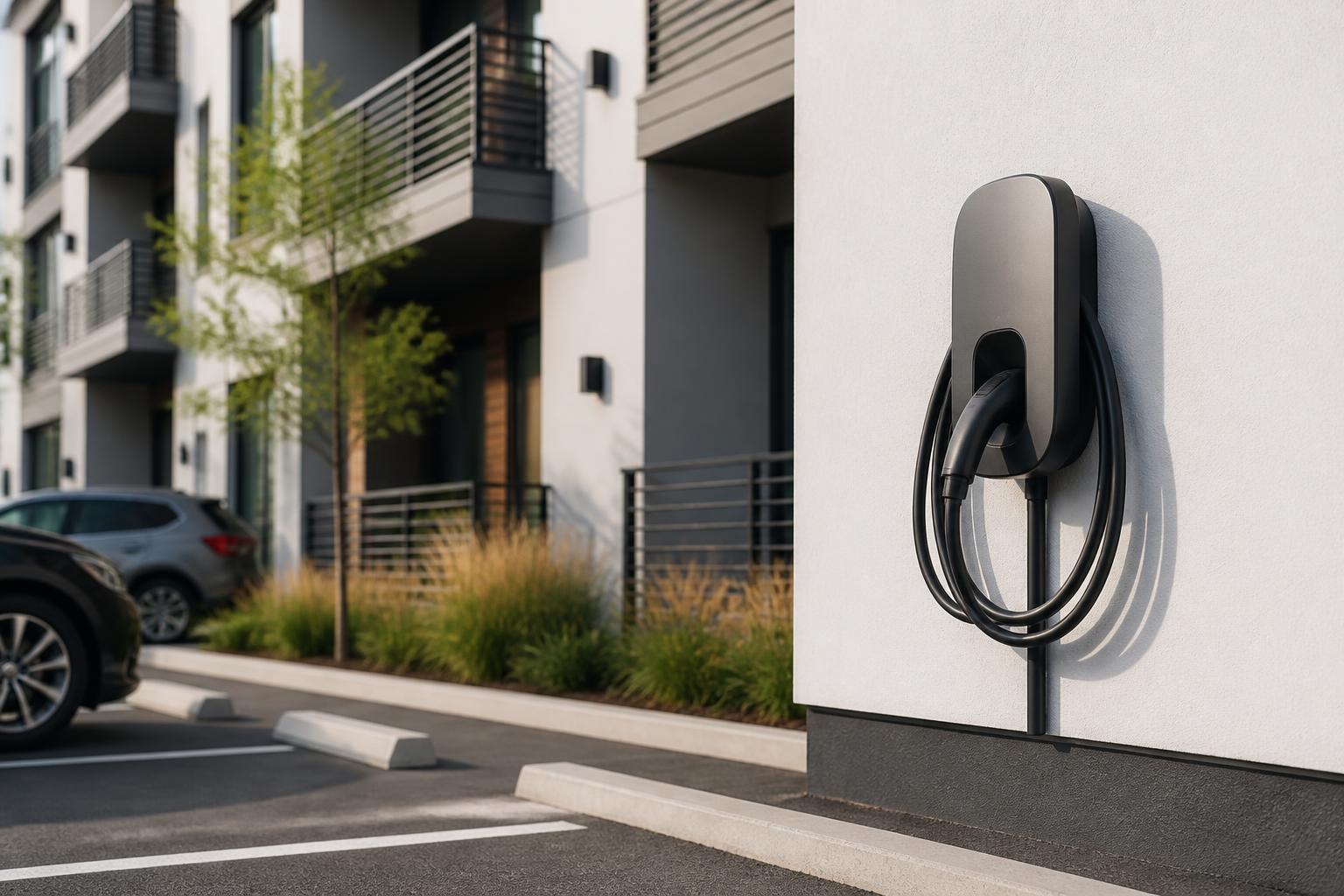
Whatever hardware standard the policy names, it is worth pointing owners toward equipment that does not lock the property into one brand of vehicle. Florida Chargers installs the Tesla Universal Wall Connector — a Level 2 unit, 48 amps, 11.5 kW, with a NACS connector and a built-in J1772 adapter. That combination charges Teslas and every other EV on the road today, not a subset of residents. A board writing hardware language into policy does not have to specify "Tesla" or any single brand; it can specify performance and safety criteria that a Tesla Certified installer already meets.
Cost and timeline are also worth building into expectations up front, even in a policy document, so owners are not surprised later. Installed cost typically runs $5,000 to $8,000 per port before incentives, and the process from a signed agreement to an energized charger typically takes six to twelve weeks. Hardware is included, and financing is available for qualified properties to cover the electrical infrastructure and installation with no money down — which is what lets an association start without drawing on reserves. The property earns a recurring share of charging revenue; the specifics are best worked out during a free site assessment. A more detailed breakdown of what drives cost at a Florida condo is available in Florida Chargers' cost guide.
This article is for informational purposes only and does not constitute legal advice. Consult a licensed Florida attorney for guidance specific to your association.
Get Ahead of the First Request
Florida Chargers is a veteran-owned, Tesla Certified commercial EV installer serving condo boards and CAMs across Florida. Board members and property managers get a documented site walk-through, a hardware and cost recommendation, and a straightforward answer on timeline before any policy language gets drafted. Reach out for a no-pressure free site assessment. Call 321-475-2689 or visit flchargers.com.
Frequently asked questions
Want a real number for your property?
Free site assessment — we'll walk the parking, check the electrical, and give you a straight, board-ready proposal.
Request a free site assessment