
Can Tesla Chargers Avoid an Electrical Service Upgrade?
Short answer: sometimes, and only a site assessment can say which. Tesla's Universal Wall Connector can be set to draw less than its full 48 amps, and Tesla's Group Power Management lets up to six connectors share one fixed current limit that the group will not exceed. Those tools help a property fit more ports onto the capacity it already has. They do not create capacity a building does not have, and Tesla's Remote Meter, the device Tesla markets as avoiding service upgrades, works with a single Wall Connector, not a parking bank.
Picture a property manager forwarding an EV charging quote to the board, and the line the board asks about is the one that says panel or service work. A per-port price alone does not tell a board member whether the building's electrical service can carry a row of chargers or whether more capacity has to be brought in.
This post sets out what Tesla actually documents about running Wall Connectors on limited capacity, where Tesla's Remote Meter fits, and what still has to be measured at the property.
Why the panel line moves the price
Florida Chargers quotes $5,000 to $8,000 per port installed before incentives. Florida Chargers includes Tesla Universal Wall Connector hardware in the installation price with no separate hardware charge. Much of the variation within that range comes from the electrical work around the charger: whether the existing panel and service can carry the design, how far conduit has to run from the electrical room to the stalls, and what trenching and permitting the site needs. The installation cost breakdown walks through each of those lines. Capacity is the one that has to be measured at the building.
What Tesla's Remote Meter does, and why it is a one-charger tool
Tesla's online shop lists the Tesla Remote Meter at $210. Tesla describes it as enabling Dynamic Power Management, which "adjusts your charge rate in real time based on the available power in your electrical panel," and says it lets an owner charge at the fastest rate possible with no electrical service upgrades required. The shop page lists it as approved for use with the Gen 3 Wall Connector and the Universal Wall Connector, notes that many homes do not require it, and advises consulting an electrician before purchasing.
The limit that matters for a condo or apartment is on Tesla's Wall Connector power management support page: Dynamic Power Management is only available for single Wall Connector installations and cannot be utilized across multiple Wall Connectors. Tesla's installation manual describes the feature in household terms, using a dryer and a water heater as the loads it works around, and calls it ideal for homes or parking spaces with limited power. For a bank of resident or guest chargers, the Remote Meter is not the tool. Tesla's tools for multiple connectors are below.
The tools Tesla documents for a bank of chargers
Configurable maximum current. Tesla's installation manual states that the Wall Connector "incorporates automatic load management, which allows the max output to be customized to an existing power supply," and that if the supply cannot support the 60-amp configuration, the installer selects a lower one. Tesla's table runs from a 60-amp breaker and 48-amp output, 11.5 kW at 240 volts, down to a 15-amp breaker and 12-amp output, 2.8 kW at 240 volts. The setting is programmed when the unit is commissioned.
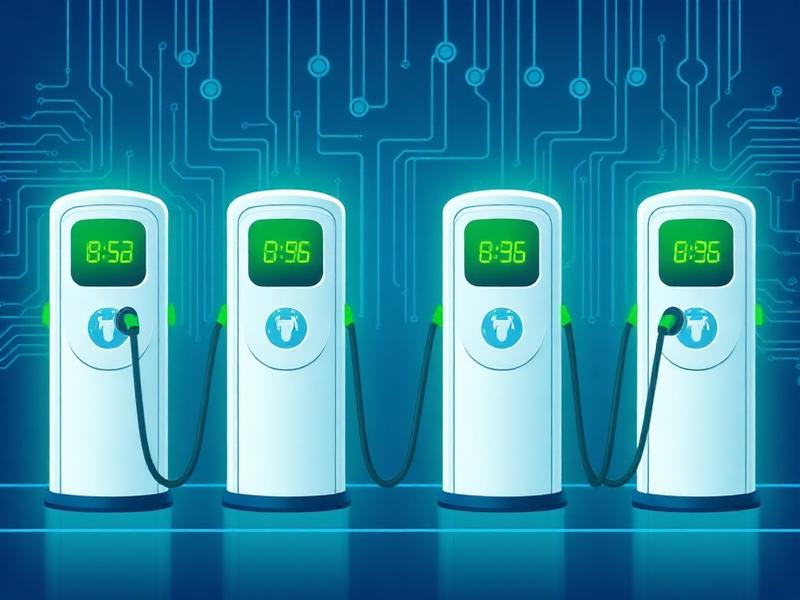
Group Power Management. Tesla describes this as a firmware feature that lets up to six Gen 3 Wall Connectors at one site share the site's total available power over unit-to-unit Wi-Fi. The electrician programs a network limit, and Tesla states that the total current output of grouped Wall Connectors "will never exceed the site's total allocated power." Tesla's manual adds that an electrician needs to determine the correct amperage and confirm the load center has appropriate overcurrent protection. If communication drops, each unit falls back to a fair-share limit equal to the network limit divided by the number of units, capped at what one unit can deliver. Tesla says the feature "minimizes the need for many residential and commercial applications to have specific electrical upgrades for concurrent multi-vehicle charging."
Daisy chaining. Tesla states that the Universal Wall Connector, and currently only that model, can feed additional Wall Connectors from its own wirebox on a single branch circuit. The maximum for a daisy chain is 48 amps on a 60-amp breaker, and every unit in the chain must be configured as one Group Power Management unit with a network limit of no more than 48 amps. Tesla recommends it at sites with more than two Wall Connectors where full power is not always needed, citing simpler site design and fewer materials.
What happens to charging speed when every port is busy
Sharing capacity means each car gets less when many charge at once. Tesla gives installers the arithmetic: available continuous amperage divided by the number of Wall Connectors equals the most each one delivers when all are in use. Tesla requires that result to be greater than 6 amps for Group Power Management to operate, caps a group at six connectors, and notes the feature is not needed if each connector could already get more than 48 amps.
As an illustration, a 96-amp network limit shared by six connectors works out to 16 amps each, which Tesla's output table lists as 3.8 kW at 240 volts. Output is lower on 208-volt building service. Tesla describes that all-ports-busy case as the worst case for charging speed and notes that in most situations not every connector is charging, so the active cars get more. A car charging alone can receive up to its connector's configured maximum, as high as 48 amps, subject to what the car itself accepts. In Tesla's daisy-chain table, two connectors sharing a 48-amp limit each deliver 5.7 kW at 240 volts while both are charging. How many ports a property needs in the first place is covered in the multifamily sizing guide.
What Tesla's panel guidance does and does not say
In the daisy-chaining appendix of its Universal Wall Connector installation manual, Tesla states that a 225 A breaker panel is preferred for a 6 Wall Connector site and a 400 A breaker panel for a 12 Wall Connector site. Because a Group Power Management network tops out at six connectors, a twelve-port site runs as more than one group.
Those figures sit in Tesla's daisy-chaining guidance and describe the panel feeding the chargers. Elsewhere, for Group Power Management generally, Tesla's manual says circuits may share a panel with other loads and that a dedicated load center may be prudent if space is limited or the main supply is far from the chargers. Either way, that panel is fed from the building's electrical service. Tesla's guidance does not say whether a given building's service has room for it. That is a site question.
What the site assessment decides
Florida Chargers does not tell a property in advance that it will avoid a service upgrade. The free site assessment is where that gets answered, typically by looking at:
- The size of the electrical service and the panels, and what they already carry.
- Whether there is panel space for new branch circuits or a dedicated load center.
- The distance from the electrical room to the proposed parking stalls.
- The port count for the first phase and for the full build, and the network limit and per-connector current that capacity supports when every port is busy.
- Which utility make-ready program, if any, applies to the property.
On that last point, two utility make-ready programs are relevant for many Florida properties. FPL's EVolution Make-Ready Credit offers up to $1,200 per Level 2 port, first-come until the program budget is depleted. Duke Energy Florida's Commercial Charger Prep Credit covers wiring, panel and conduit work and excludes hardware and permits. Eligibility is confirmed with the serving utility. The Florida utility make-ready guide has the details.
Under Share the Revenue, the property invests in the professional installation and Florida Chargers owns and operates the chargers, then the property shares in net charging profit for the full term. Tesla Wall Connector hardware is included. Financing is available for qualified properties to cover the electrical infrastructure and installation with no money down. A project typically runs 6 to 12 weeks from signed agreement to energized. The apartment EV charging page covers how a multifamily project is put together.
Florida Chargers is a veteran-owned, Tesla Certified commercial EV installer serving condo associations and apartment communities across Florida. The assessment looks at what the existing service can carry. Reach out for a no-pressure free site assessment. Call 321-475-2689 or visit flchargers.com.
This article is for informational purposes only and does not constitute legal or financial advice, or an electrical design for any property. Tesla product descriptions, specifications, prices and utility program terms are subject to change; the Tesla and utility details described here were verified in October 2026. Confirm current terms with the manufacturer or utility directly, have a licensed Florida electrical contractor evaluate a specific site, and consult a licensed Florida attorney for guidance specific to your association or property.
Frequently asked questions
Want a real number for your property?
Free site assessment — we'll walk the parking, check the electrical, and give you a straight, board-ready proposal.
Request a free site assessment