
Owner EV Charger Requests Under 718.113(8): A Defensible Board Process
A unit owner hands the property manager a written request: they want to install an EV charger in their assigned parking space. The manager forwards it to the board. Someone on the board pulls up Florida Statute 718.113(8) and reads the operative phrase — the association may not prohibit the installation, subject to the subsection's conditions — and then sits with the obvious follow-up question: how does the board apply those conditions the same way every time?
This is the moment most boards get stuck. Not because they want to say no. Because they don't know what saying yes is supposed to look like, procedurally, in a way that holds up if a second owner asks next month and a third the month after that.
Short answer: 718.113(8) does not mean a board must approve every EV charger request with no conditions attached. It means the board needs a consistent, written standard it applies to every unit owner the same way — hardware type, permitting, insurance, a response timeline — rather than ad hoc yes-or-no decisions made case by case with no criteria at all. A board with a documented process that treats every request equally is in a defensible position even when it asks owners to meet conditions before approval.
What Does the Statute Actually Say?
Florida Statute 718.113(8) says a board may not prohibit a unit owner from installing an EV charging station within the owner's limited common element or exclusively designated parking area, subject to the subsection's conditions: no irreparable damage, separate or embedded metering paid by the owner, and the items listed in (8)(h) that the association may require. It does not prescribe the internal process for applying those conditions. That leaves boards doing the work themselves, and a board's decisions tend to be judged by the process they came from, not just the outcome.
A board that denies a request outright, with no stated reason, no written standard, and no explanation for why a similar request from a different owner was approved last year, has a process problem regardless of whether the underlying denial had a legitimate basis. A board that approves the request subject to written, consistently applied conditions — even conditions the requesting owner finds inconvenient — has a much stronger footing. The practical answer is: build a process around the statute's conditions, apply it every time, and write it down.
Reasonable Conditions Are Not the Same as Denial
This distinction is the one boards most often miss. Conditioning approval on a licensed electrician, a county permit, or a specific mounting location is not denying the request — it's the board exercising its legitimate interest in how the common elements and shared electrical infrastructure get modified. The statute targets prohibition, not conditions. It doesn't strip a board of the ability to apply the conditions it allows. Florida's Second District Court of Appeal decision in Persechino v. Station Square also read the (8)(h) list as not exhaustive and held that an owner install that materially alters the common elements needs approval under 718.113(2)(a).
What crosses the line is treating the conditions as a moving target. If the board approves owner A's charger with a permit requirement and denies owner B's identical request outright, or approves B only after adding new requirements that weren't asked of A, that inconsistency is the actual exposure — not the existence of conditions in the first place.
The Five Building Blocks of a Defensible Process
None of what follows is legal advice — it's a description of the categories that boards commonly cover when building a written EV charger policy, and any board should confirm its specific approach with association counsel. But as informational content, a defensible review process typically addresses five things.
A written installation standard comes first: what hardware is permitted, what equipment specifications apply, and where on the owner's designated space it may be mounted. Second, a permitting and inspection requirement — the work has to be done by a licensed electrician and pulled through the county, not installed quietly by a handyman on a Saturday. Third, an insurance or indemnification step, so the association has some protection tied to work happening on or near the common elements. Fourth, a timeline the board commits to for responding. The statute sets no deadline, but a board that sits on a request for months without a response or a documented reason for the delay is inviting the argument that the delay itself was a prohibition. Fifth, documentation of every decision — approved, denied, or conditioned — so the board can show, if it's ever asked, that owner requests have been handled consistently rather than case by case with no record at all.
Put together, those five pieces turn the statute's conditions into a process the board actually controls.
The Smarter Long-Term Play: Subsection (9)
Every one of those five steps has to be repeated each time a new owner submits a request under subsection (8). That's the reactive model — one owner, one request, one round of review, indefinitely.
Subsection (9) offers a different path. It states that a board installing EV charging on the common elements is not a material alteration, so it generally doesn't require a full membership vote to move forward. A board that builds a shared charging system under (9) is making one decision instead of many, and it largely sidesteps the recurring judgment calls that (8) forces one owner at a time. Florida Chargers' earlier post on 718.113 covers what subsection (9) actually says and why it tends to be the lower-friction option for a board managing a building rather than a single space. For boards weighing what a common-element system costs relative to fielding individual requests indefinitely, the cost guide for Florida condos and the broader Florida HOA and condo EV charger law overview are useful starting points.
One Charger, Every Car
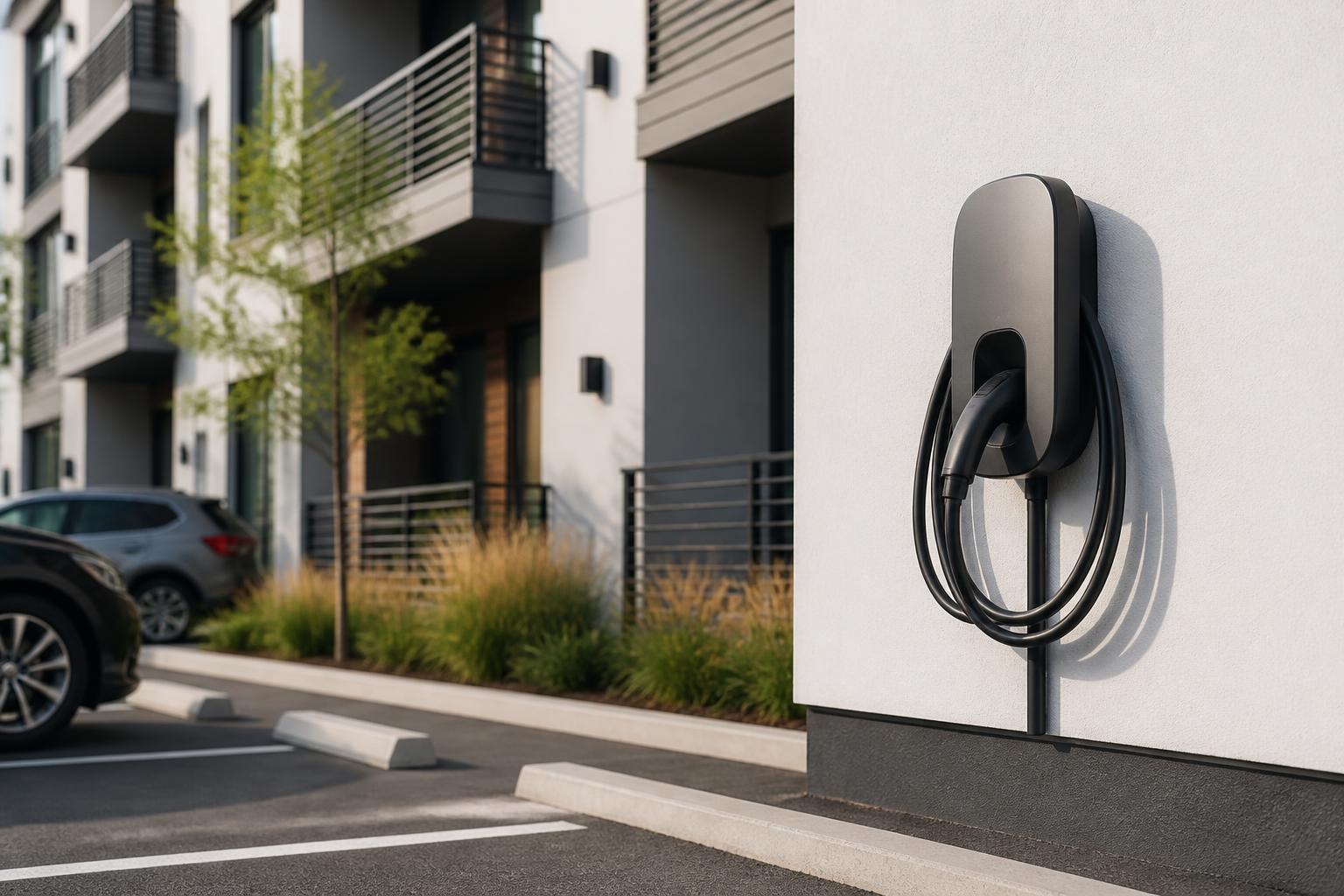
Whichever path a board takes, the hardware question tends to come up fast: what happens when the building has a mix of EV brands, or none yet, and someone asks whether a charger is a Tesla-only amenity. Florida Chargers installs the Tesla Universal Wall Connector — Level 2, 48 amps, 11.5 kW, with a NACS connector and a built-in J1772 adapter. That means it charges every EV on the road today, not just Teslas. A board approving one charger under 718.113(8), or building a shared system under 718.113(9), isn't locking the property into a single manufacturer's ecosystem.
This article is for informational purposes only and does not constitute legal advice. Consult a licensed Florida attorney for guidance specific to your association.
Florida Chargers is a veteran-owned, Tesla Certified commercial EV installer serving condominium boards and property managers across Florida. Boards get a documented, standards-based installation whether the request comes in under 718.113(8) or the board moves forward with a common-element system under 718.113(9). Reach out for a no-pressure free site assessment. Call 321-475-2689 or visit flchargers.com.
Frequently asked questions
Want a real number for your property?
Free site assessment — we'll walk the parking, check the electrical, and give you a straight, board-ready proposal.
Request a free site assessment