
EV Charging for Florida Apartment Communities: What It Actually Costs in 2026
A leasing agent finishes a tour of a two-bedroom, walks the prospect back across the parking lot, and gets the question that keeps coming up: is there anywhere here to charge a car?
At most Florida apartment communities the honest answer is still no. The follow-up — what would it cost to change that — is where the conversation stalls, because nobody on the ownership side has a number to give. The vendor quotes that do arrive tend to be a single lump sum with no breakdown, which is impossible to compare against anything.
Short answer: Florida Chargers installs Level 2 charging at Florida apartment communities for $5,000 to $8,000 per port before incentives, with Tesla Universal Wall Connector hardware included in that price. A 200-unit community sized at the standard multifamily starting ratio needs roughly seven to ten ports, which puts a first phase between $35,000 and $80,000 before any utility credit is applied. Timeline runs 6 to 12 weeks from signed agreement to energized charger.
The rest of this is where that number comes from, and what moves it.
What a port actually costs
The working range is $5,000 to $8,000 per installed port before incentives. That is Florida Chargers' own installed pricing across Florida multifamily work, and it includes the Tesla Universal Wall Connector hardware — there is no separate hardware line item.
A port is one charging position, not one parking space served. Eight ports means eight cars charging at once.
The reason that is a range and not a price is that the charger is the most predictable part of the job. Every property gets the same unit. What differs is everything around it.
How many ports a community actually needs
Florida Chargers uses roughly one Level 2 port per 20 to 30 units as a multifamily starting point. That is a planning baseline, not a code requirement and not a hard rule.
Run it out and the arithmetic is straightforward. A 200-unit community lands at seven to ten ports. A 300-unit community lands at ten to fifteen. At $5,000 to $8,000 per port, a 200-unit first phase falls between $35,000 and $80,000 before incentives.
That ratio moves with the property. Unit mix, resident demographics, how much of the parking is assigned, and how much spare electrical capacity the site already has all push the right number up or down. Most communities are also better served phasing — putting in the first bank, watching utilization for two or three quarters, then expanding into conduit that was already sized for it. Trenching twice costs considerably more than trenching once for future capacity. Florida Chargers covers the multifamily sizing approach in more detail on its Florida apartment EV charging page.
Where the money actually goes
The equipment is the consistent part. The variables are electrical and civil:
- Available service capacity. If the existing panel has room, the job is far simpler than if the property needs a new panel or a service upgrade.
- Distance. How far conduit has to run from the electrical room to the parking stalls, and whether that run is overhead, through existing pathways, or trenched through finished pavement.
- Parking layout. Wall-mounted units in a structured garage behave differently from pedestal-mounted units in an open surface lot.
- Permitting and utility coordination. Requirements vary by jurisdiction and by utility, and both sit on the critical path.
Two Florida communities with identical unit counts can land at opposite ends of the range on those factors alone. That is why Florida Chargers starts every apartment project with a free site assessment instead of quoting a flat per-port price over the phone.
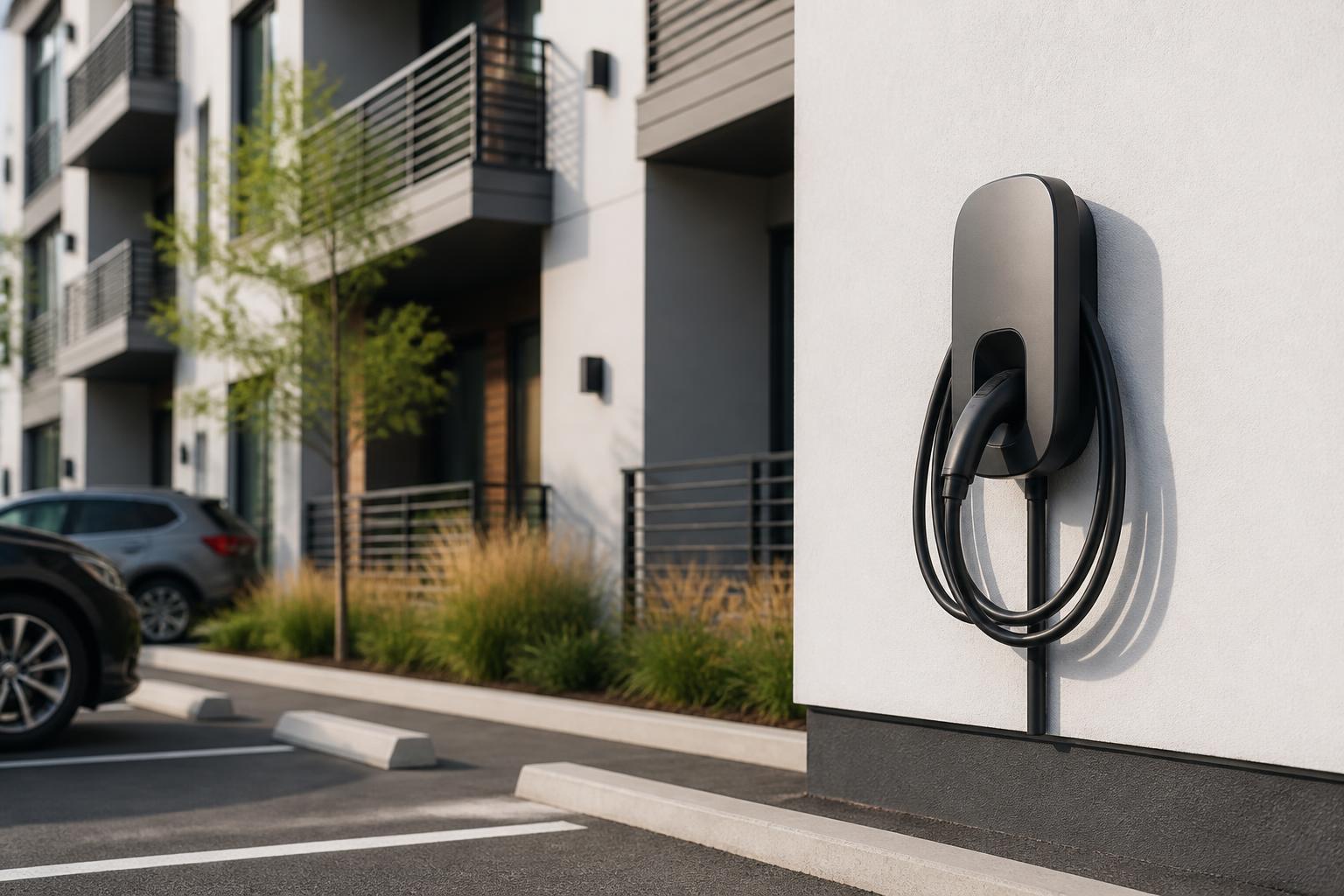
On the hardware itself: the Tesla Universal Wall Connector is a Level 2 unit rated at 48 amps and 11.5 kW, with a NACS connector and a built-in J1772 adapter. It charges Teslas and it charges everything else on the road. Residents do not need to know which one they have. What that unit does for a property is covered in this breakdown of Level 2 charging as a property asset.
What Florida utilities still cover
Two live utility programs are worth checking before a budget is set.
FPL's EVolution Make-Ready Credit offers up to $1,200 per port toward make-ready electrical work, awarded first-come until the program budget is depleted.
Duke Energy Florida's Commercial Charger Prep Credit covers wiring, panel work, and conduit. It excludes hardware and permits.
Both are utility programs with their own eligibility rules and finite budgets, so availability should be confirmed with the utility before a credit is written into a pro forma. On an eight-port project, an FPL credit at the top of its stated range would offset up to $9,600 of make-ready cost.
What the amenity is doing for occupancy
The cost question only matters against what the charging is worth, and the demand side in Florida is not speculative.
Florida has 450,400 registered electric vehicles, second only to California's 1,843,100, out of 5,689,100 nationwide, according to U.S. DOE Alternative Fuels Data Center 2025 data derived by the National Laboratory of the Rockies from Experian Information Solutions. Those cars are already parked somewhere every night.
A 2024 SWTCH Energy survey of 1,567 multifamily residents across Boston, Chicago, Los Angeles, and Miami/Tampa found that 62 percent of residents plan to own or drive an EV within five years when charging is available at their property, against 25 percent when it is not. In the same survey, 31 percent of residents who do not own an EV named the lack of charging at their building as a barrier.
That is the part worth sitting with. A community without charging is not simply missing an amenity — it is filtering its own applicant pool. Property-specific numbers can be modeled on the Florida Chargers ROI calculator.
How the project gets paid for
There are two ways an apartment owner typically funds this.
The first is direct capital. The property pays for the professional installation the way it would pay for repaving or a fitness center refresh, and the asset is in service from day one.
The second is financing. Financing is available for qualified properties to cover the electrical infrastructure and installation with no money down, which is the only mechanism that lets a project start without a capital outlay from the operating budget.
Either way, the operating structure is the same. Under Share the Revenue, the property invests in the professional installation, Florida Chargers owns and operates the chargers, and the property earns a share of net charging profit for the full term of the agreement. Net means gross session revenue less electricity and network fees. Tesla Wall Connector hardware is included. Florida Chargers handles monitoring, support, and maintenance, so a broken charger is a vendor call and not a maintenance ticket.
Timeline, and why apartments move faster than condos
Six to twelve weeks from signed agreement to energized charger is the typical range. That covers design, permitting, utility coordination, installation, and commissioning.
Apartment communities generally move at the faster end of that window for a structural reason rather than a technical one: there is no board in the path. Florida's condominium and homeowners' association statutes govern condos and HOAs, not privately owned rental communities. There is no membership vote, no board review standard, and no annual meeting to wait for. The decision belongs to the owner or the asset manager directly — a point covered in full in this post on why apartment owners do not need board approval.
The two steps most likely to add time are utility coordination and the local permit office, and neither is entirely within an installer's control. A realistic schedule accounts for both rather than assuming the best case.
What to ask for
An apartment owner comparing options should be able to get, in writing: the port count and the ratio it was derived from, the per-port installed cost, what the electrical scope actually includes, which utility programs the property qualifies for, the permitting path for that jurisdiction, and who owns and maintains the equipment after it is energized. A quote that cannot itemize those is not a quote, it is a number.
Florida Chargers is a veteran-owned, Tesla Certified commercial EV installer serving apartment communities and asset managers across Florida. An asset manager gets a port count, an installed cost, and a permitting path specific to the property instead of a rule of thumb. Reach out for a no-pressure free site assessment. Call 321-475-2689 or visit flchargers.com.
This article is for informational purposes only and does not constitute legal advice. Pricing and utility incentive programs are subject to change and to eligibility requirements. Consult a licensed Florida attorney for guidance specific to your property.
Frequently asked questions
Want a real number for your property?
Free site assessment — we'll walk the parking, check the electrical, and give you a straight, board-ready proposal.
Request a free site assessment